
The Accidental Manager Index
6 Min Read

Many people who manage a team at work were never taught how to do so. They were strong individual contributors, so their employer handed them direct reports and hoped for the best.
New research conducted on behalf of Benedictine University surveyed 544 U.S. professionals who currently manage or once managed a team about their experiences. The results describe a workforce of accidental managers who were promoted for yesterday’s job and left to figure out the rest on their own. They also point to what these managers say would have made the difference.
Key Takeaways
- 77% of managers were promoted into their first management role with no formal training.
- Just 25% of managers were promoted for demonstrated leadership ability. The rest advanced on past job performance, seniority or availability.
- 74% of managers hid how unprepared they felt from their team or boss, rising to 87% among Gen Z managers.
- 56% of managers received no management training or not enough, even after being promoted.
- 43% of managers say the skill they most wish they had been taught is coaching and developing people.
- 61% of managers say formal management education would have made them competent faster, and 81% would enroll in a structured program if their employer paid for it.
- 63% of managers have turned to AI tools like ChatGPT or Claude for advice on managing someone, climbing to 70% among millennial managers.
Most Managers Were Never Taught to Manage
The road into management usually started without a map. For most professionals, the promotion arrived before any preparation did, leaving them to learn how to lead while the job was already underway.
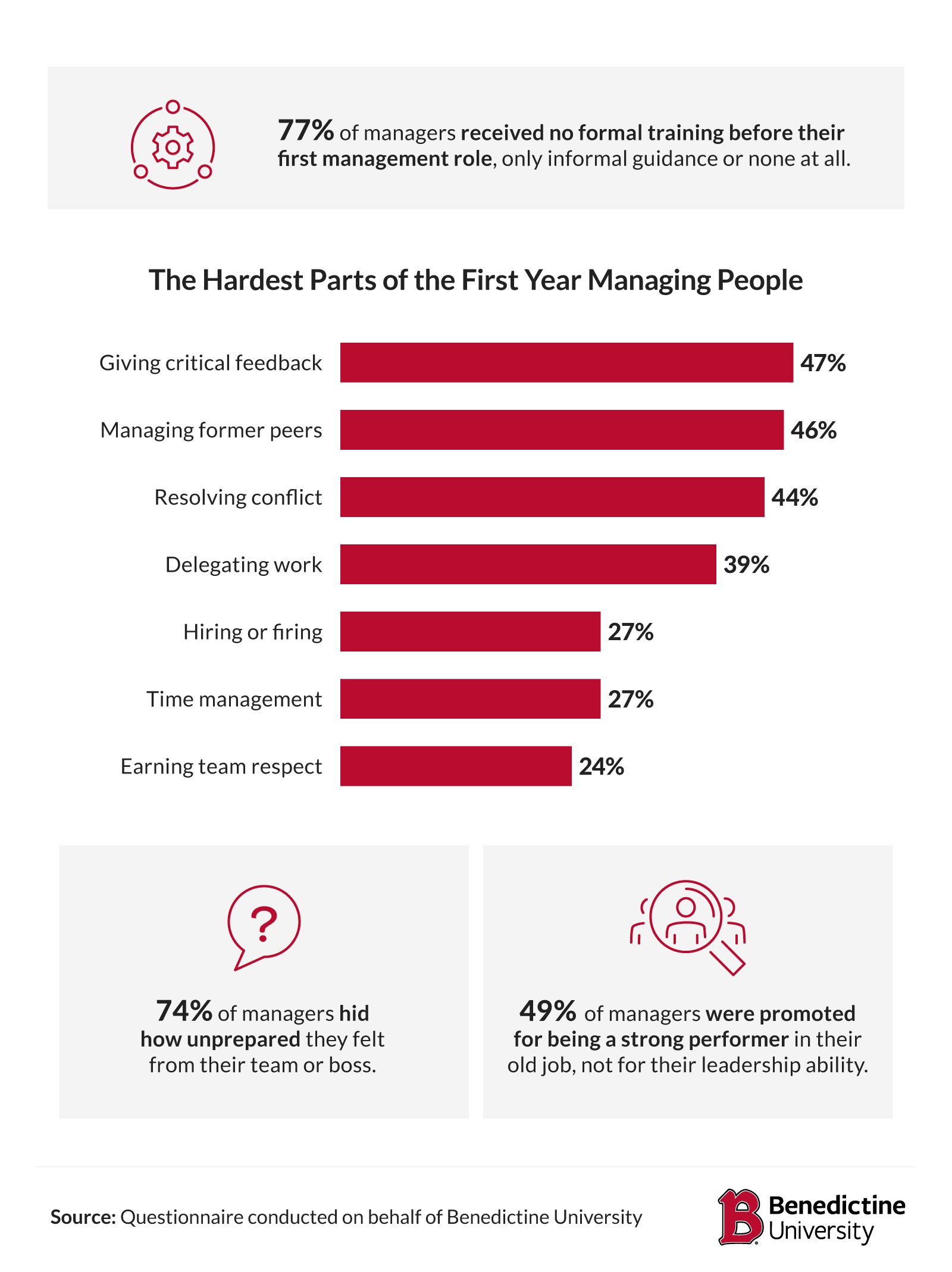
Nearly four in five managers (77%) received no formal training before their first management role, and just one in four (25%) were promoted for demonstrated leadership ability. The rest advanced on past job performance, seniority or availability, which meant three in four (75%) stepped into the role for reasons that had little to do with leading people. The learning curve showed up fast, with giving critical feedback (47%), managing former peers (46%) and resolving conflict (44%) ranking as the hardest parts of the first year.
Many kept the struggle to themselves. Nearly three in four managers (74%) hid how unprepared they felt from their team or boss, a share that climbed to 87% among Gen Z managers. About three in five (61%) worried they had negatively affected someone on their team. Baby boomers were the most likely to have started with nothing, at 88%, compared with 76% of Gen X, 74% of millennials and 71% of Gen Z managers.
More People to Manage, Less Support to Do It
Once the title arrived, the workload rarely made room for it. New managers were expected to lead a team while maintaining their previous responsibilities, often with little additional support to manage both.
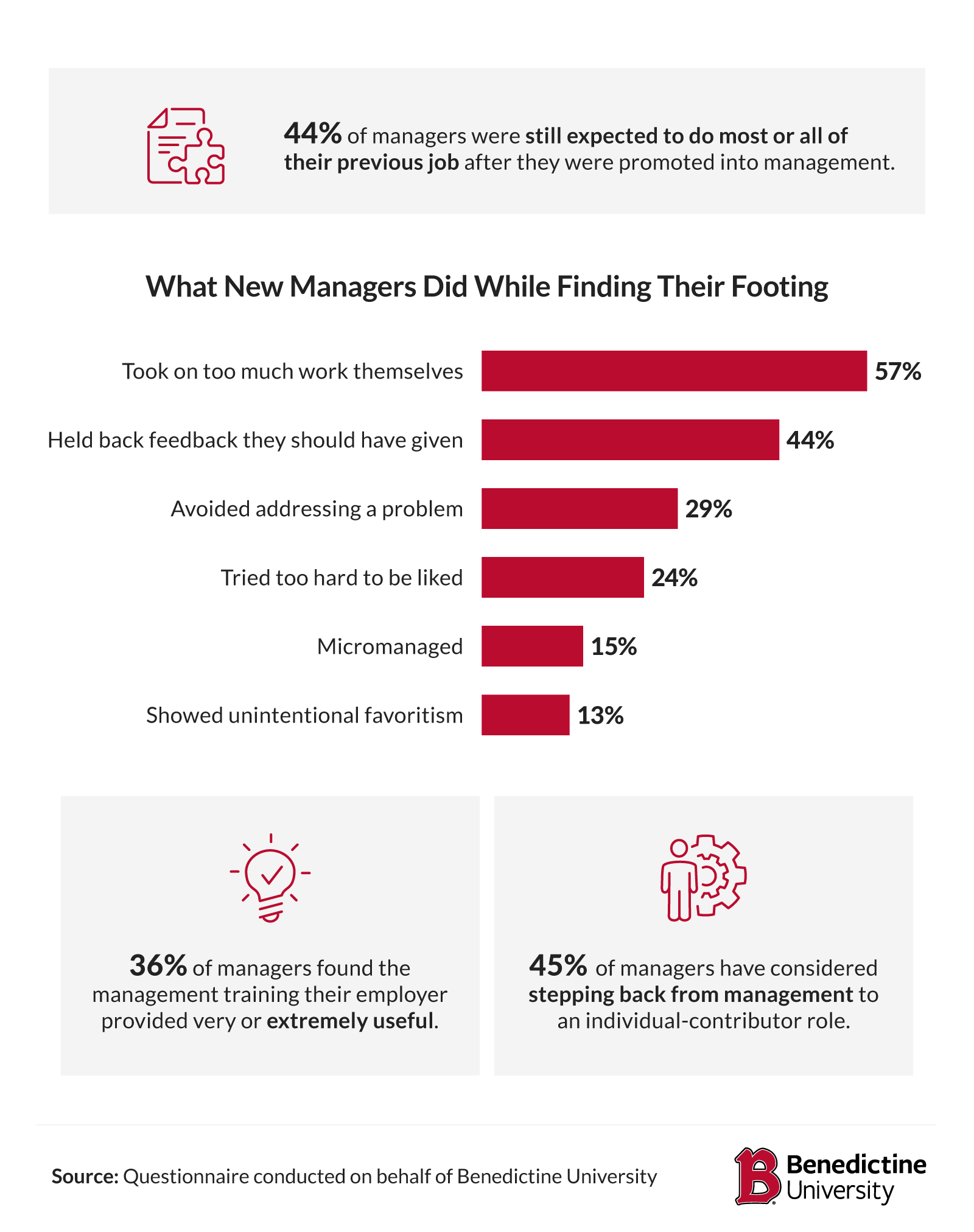
After the promotion, the old job often stayed. More than two in five managers (44%) were still expected to do most, or all, of their previous role on top of managing, and their coping strategies showed the strain. Most new managers took on too much of the work themselves (57%), and 44% held back feedback they should have given, while smaller numbers avoided problems (29%) or tried too hard to be liked (24%).
Support was thin. More than one in five managers (22%) received no employer training after being promoted, and another 34% said what they received fell short. Of those who did get training, only 36% found it very or extremely useful.
Finding their footing took time, as half of managers (50%) felt competent within their first year, led by 60% of Gen Z but just 42% of Gen X managers. Nearly one in five (18%) needed two years or longer. The pressure took a toll, with nearly half (45%) saying they had considered stepping back to a non-management role.
What Managers Say Would Have Helped
Asked what they needed, managers pointed in a clear direction. Their answers centered on the people skills and structured support that would have helped them lead with confidence from the start.
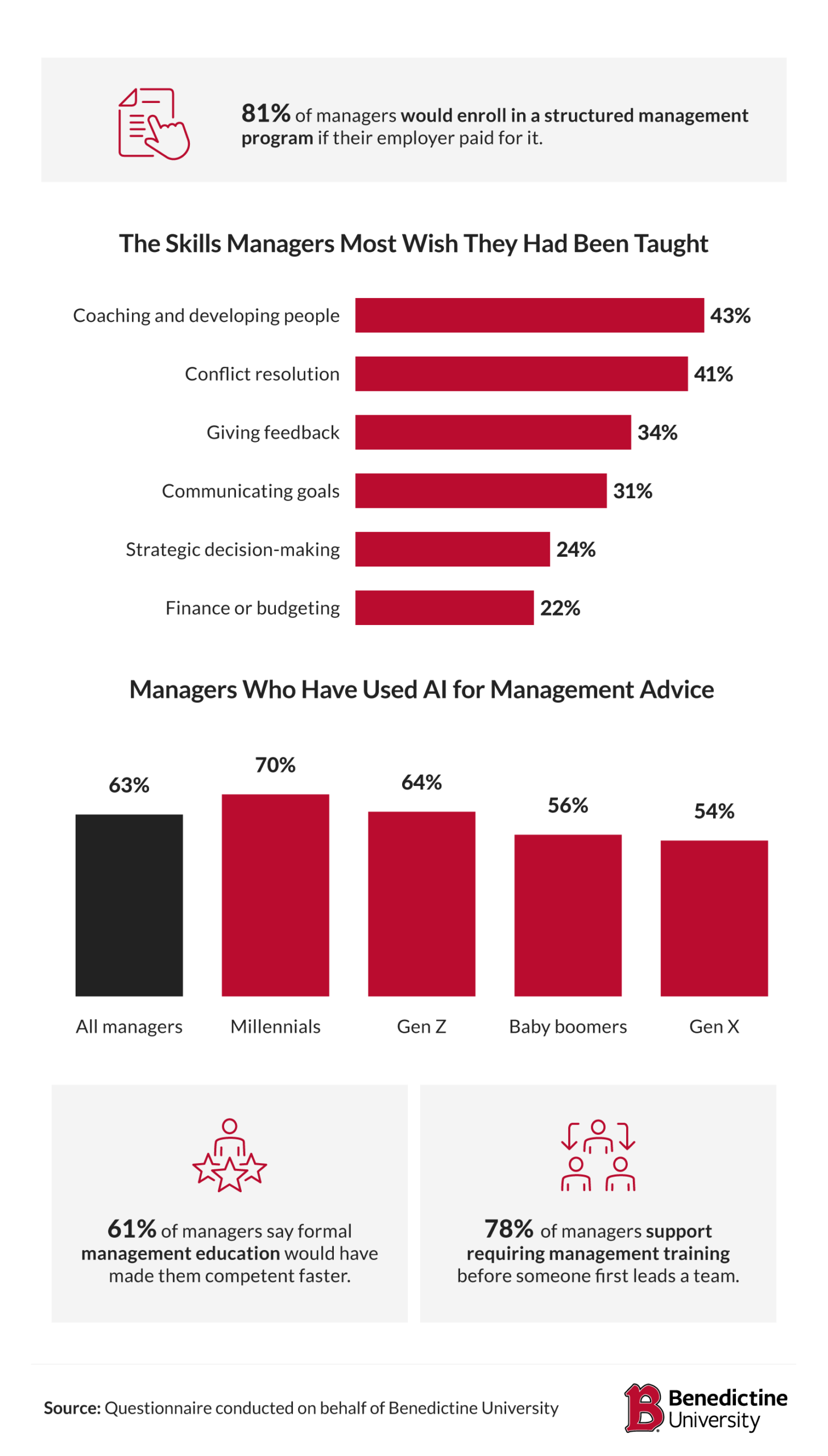
The skill managers most wished they had been taught was coaching and developing people (43%), followed by conflict resolution (41%) and giving feedback (34%). Asked what would have helped most as a new manager, more than two in five (42%) named a mentor, just ahead of formal training or coursework (40%). In the meantime, many turned to whatever was on hand, as nearly two in three managers (63%) had used AI tools such as ChatGPT or Claude for advice on managing someone, with the rate rising to 70% among millennial managers.
There was a broad appetite for a more structured fix. About four in five managers (81%) said they would enroll in an employer-paid management program, and three in five (61%) said formal management education would have made them competent faster, a view held by 76% of Gen Z managers. Support extended to policy, with 78% backing a requirement to complete management training before someone leads a team for the first time. Despite the rocky start, nearly three in four (73%) would still recommend management to a younger colleague.
Turning Accidental Managers Into Prepared Ones
The accidental manager is less a failure of individual people than of how companies hand out leadership. Managers were promoted for the wrong reasons, given no training and left to learn in front of the teams depending on them, and most of them knew it.
The clearest signal in the data is how ready these managers are to close the gap, whether through mentorship, structured coursework or formal management education. Employers who invest in preparation before a promotion, rather than hoping competence will arrive on its own, stand to retain stronger managers and healthier teams.
Methodology
A questionnaire was conducted in July 2026 on behalf of Benedictine University of 544 employed U.S. professionals aged 18 or older who currently manage or have previously managed at least one direct report, about their experience of becoming and working as a manager. Respondents were distributed across genders and generations. The gender breakdown was men (56%) and women (43%), with 1% non-binary or preferring not to answer. The generational breakdown was millennials (49%), Gen X (27%), baby boomers (15%) and Gen Z (9%).
All percentages are rounded to the nearest whole number, so figures may not total 100%. These findings are directional and should be treated as indicative rather than statistically representative of the broader population of U.S. professionals.
About Benedictine University
Benedictine University offers flexible online degree programs designed for working professionals who want to advance their careers while balancing work and personal commitments. The online Master of Business Administration (MBA) program equips students with leadership, strategic decision-making, marketing and organizational management skills that support career advancement across a variety of industries.
Fair Use Statement
The information presented in this article may be shared for noncommercial purposes only. If you reference or republish these findings, please provide proper attribution and include a link back to Benedictine University.