
Entry-Level Isn’t Entry-Level Anymore
6 Min Read

Entry-level jobs are supposed to be a starting point, but many now come with experience requirements that can make them feel out of reach. In this survey, 43% of hiring managers said they expect at least two years of experience for roles they advertise as entry-level. Early-career professionals are noticing that bar, and many are deciding not to apply.
Benedictine University works with adults who return to school to compete for the next role, so the widening gap between a first job and a first resume matters to that mission. To measure it from both sides, Benedictine surveyed 200 hiring managers involved in filling roles their organizations advertise as entry-level, along with 200 recent graduates and early-career professionals who finished their degrees between 2021 and 2026. The two groups describe the same shift from opposite ends of the hiring process.
Key Takeaways
- Entry-level now means two years: 43% of hiring managers expect at least two years of experience from candidates.
- 39% of hiring managers say the bar for entry-level work is higher than it was five years ago.
- AI tools have made 26% of hiring managers more willing to hire someone with little or no work experience.
- 84% of early-career professionals have skipped applying to an entry-level job because of the experience it demanded.
- 59% of early-career professionals say their education did not prepare them to use AI tools at work.
- 58% of early-career professionals are taking on extra responsibilities at their current jobs to build skills, while 23% are pursuing a graduate degree.
What Hiring Managers Now Mean by Entry-Level
Hiring managers report higher expectations for entry-level candidates than they had five years ago. Many also expect candidates to arrive with skills they can use from day one. What employers offer in return and what they expect next help show how the category is changing.
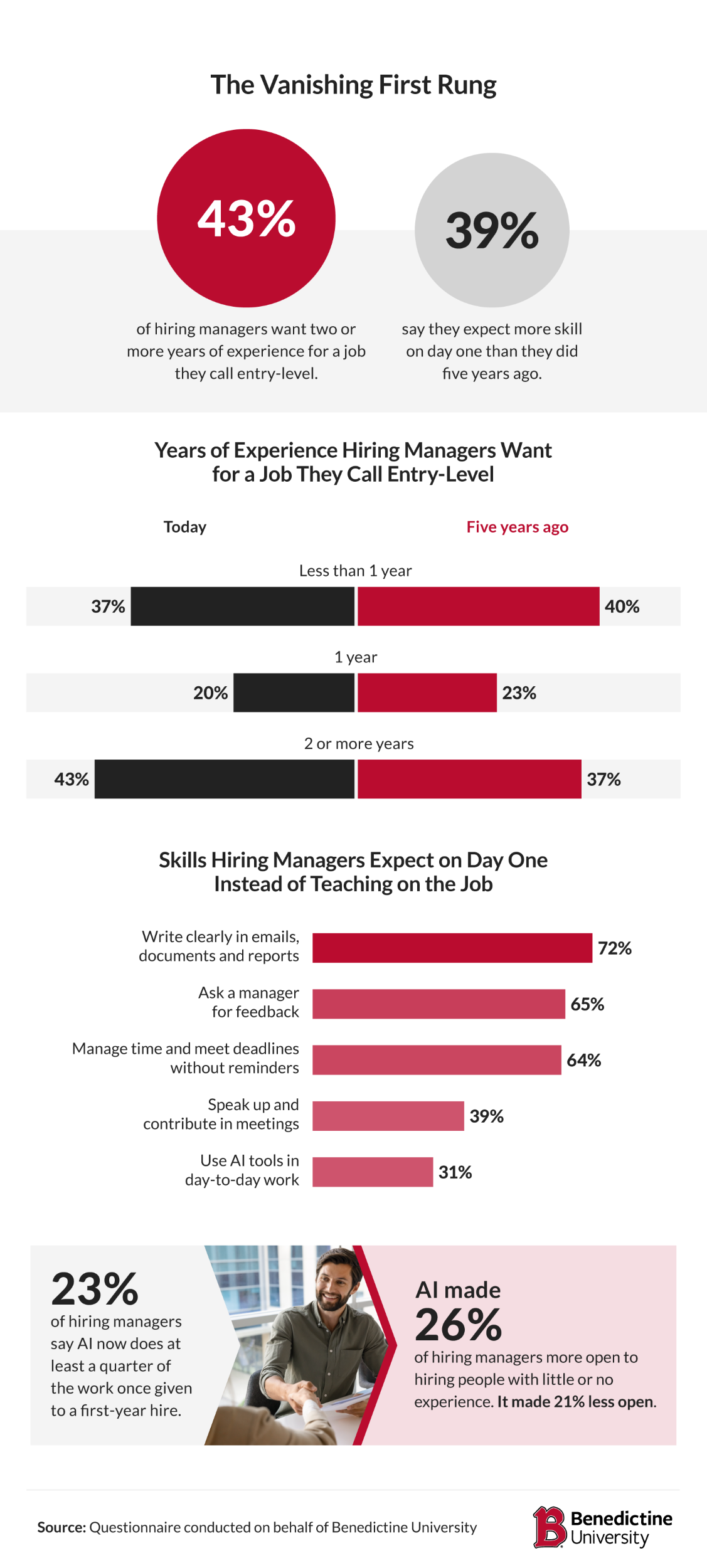
Prior experience has become the norm rather than the exception. Among hiring managers, 43% expect at least two years of experience from entry-level candidates, and 39% said the bar for this work sits higher than it did five years ago. The label has drifted away from its plain meaning.
For some new hires, formal onboarding is limited. Formal, structured training in a new hire’s first 30 days runs to eight hours or less, according to 28% of hiring managers. Hiring managers also report higher expectations for entry-level work than they did five years ago.
Artificial intelligence cuts in an unexpected direction here. AI tools have made 26% of hiring managers more willing to hire someone with little or no work experience. For some hiring managers, AI may be lowering one barrier to entry.
More hiring managers expect entry-level hiring to increase than decrease over the next two years. Among hiring managers, 46% expect their organization to hire for more entry-level positions over the next two years, while 26% expect fewer. That leaves candidates facing more demanding requirements even as some employers plan to expand entry-level hiring.
The Gap Graduates Feel and What They Do About It
Early-career professionals see those experience requirements and often respond by narrowing their own search. In the survey, 84% had skipped an entry-level application because of the experience it demanded. What they do next shows how many are trying to build the skills or credentials they feel they need.
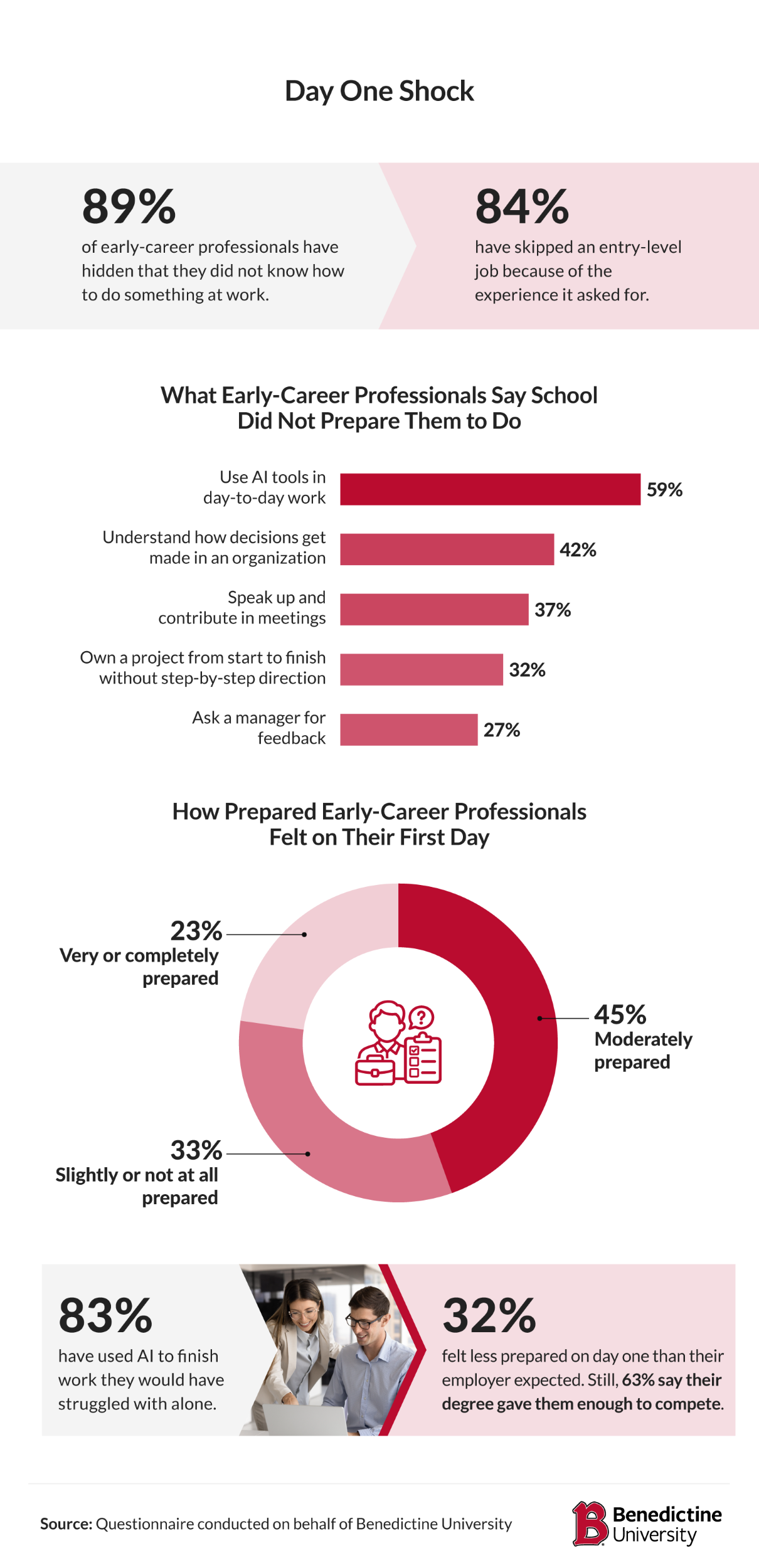
Self-selection out of the process is widespread. Among early-career professionals, 84% have skipped applying to an entry-level job because of the experience it demanded. Many potential applicants are removing themselves from consideration before a recruiter ever sees them.
Preparation for AI tools stands out as the clearest gap. Among respondents, 59% said their education did not prepare them to use these tools at work. That finding comes with important context: 74% completed their degree in 2023 or earlier, before generative AI became standard in most workplaces.
Confidence, by contrast, holds up reasonably well. Among early-career professionals, 68% feel personally ready for the responsibilities of the next job they want, and 56% said the skills their degree taught match what their current job requires.
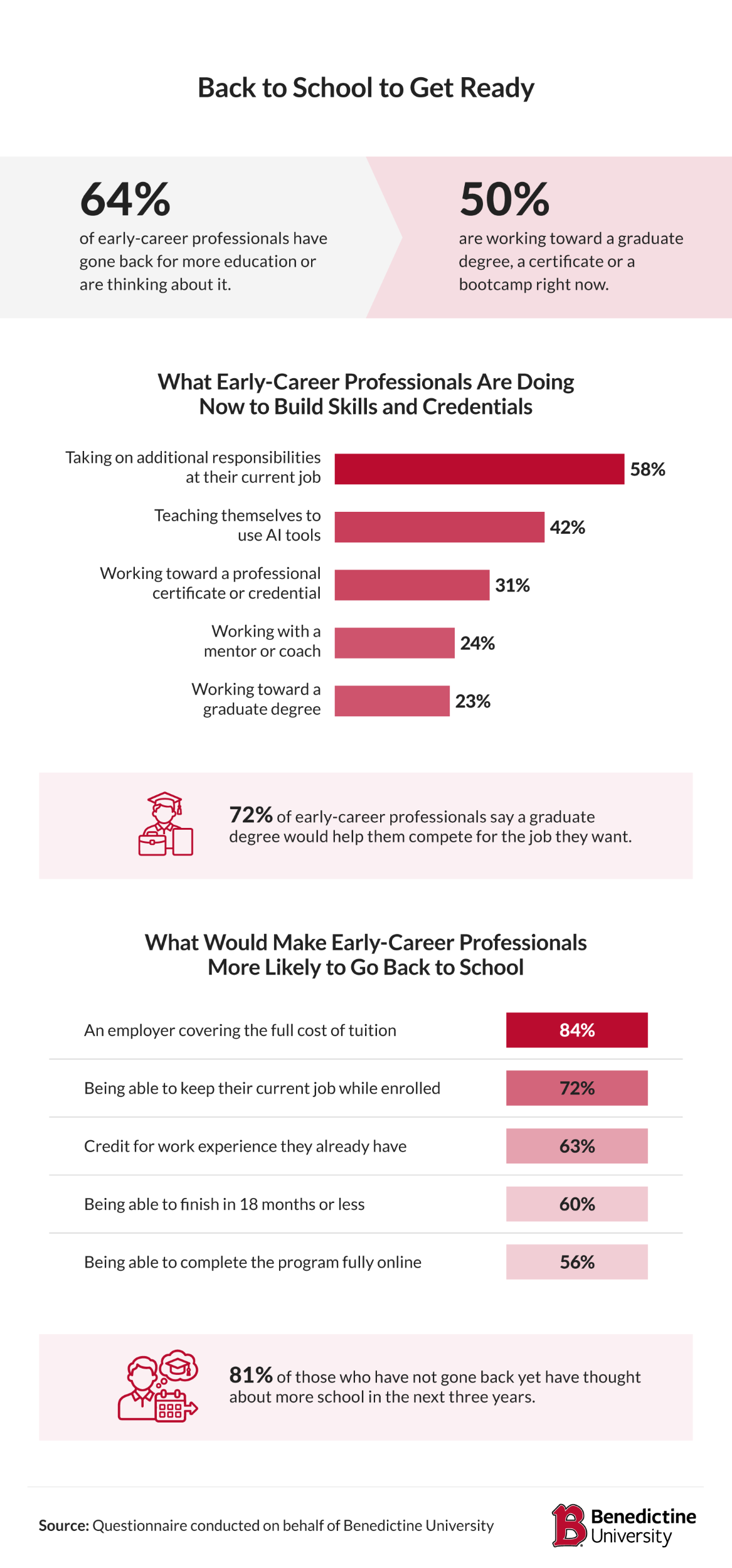
Action follows that assessment. Taking on extra responsibility at a current job to build skills is the most common strategy, chosen by 58%, while 23% are working toward a graduate degree. Both routes point toward the same goal of arriving at the next application with more to show.
Why More Education Feels Out of Reach
Early-career professionals have their own views of what employers value when making decisions about where to invest their time. That perception can shape whether additional education feels worthwhile. The barriers they report include cost, time and uncertainty about the return.
Experience outranks credentials in how this group believes employers assign value. Among early-career professionals, 75% believe employers value years of prior work experience very much or extremely, compared with 61% for a bachelor’s degree and 60% for a graduate degree. That perceived difference may factor into decisions about further education.
Cost and time lead the list of obstacles standing between these professionals and further education:
- Cost of tuition: 66%
- The time commitment required: 58%
- Uncertainty about whether it would lead to better opportunities: 43%
- Uncertainty about whether it would lead to higher pay: 37%
- Family or caregiving responsibilities: 20%
For this group, cost and time are the two most commonly cited barriers to further education.
Meeting a Higher Bar
Hiring managers report higher expectations for entry-level candidates, while many early-career professionals are responding by building skills on the job or pursuing additional credentials. More hiring managers expect entry-level hiring to increase rather than decrease over the next two years, but many early-career professionals have already skipped applications due to experience requirements.
Cost and time are the most common barriers to further education, while uncertainty about career opportunities and pay also plays a role. The findings show how early-career professionals are trying to close specific skill and experience gaps as they prepare for their next move.
Methodology
We conducted two surveys, one of 200 hiring managers in the United States who are involved in hiring for roles their organization advertises as entry-level, and one of 200 recent graduates and early-career professionals in the United States about their first years of work. Their gender breakdown was men (54%) and women (45%), with the remainder non-binary or preferring not to answer. The generational breakdown was as follows: millennials (55%), Gen X (29%), Gen Z (13%) and baby boomers and older (4%).
Among the early-career professionals, all have held at least one full-time professional or career-track job, and all completed the degree that got them into their field between 2021 and 2026. Their gender breakdown was women (54%) and men (45%), with the remainder non-binary or preferring not to answer. The generational breakdown was as follows: Gen Z (54%), millennials (42%), and Gen X (5%). On the highest completed degree, 70% hold a bachelor’s degree, 24% a master’s and 7% a doctoral or professional degree. Both surveys were conducted in September 2026. All percentages are rounded to the nearest whole number, so totals may not equal 100%.
About Benedictine University
Benedictine University Online offers undergraduate, graduate, doctoral and certificate programs designed for students balancing education with work and other responsibilities. Its online options span fields including business, nursing, public health, psychology, technology and criminology, with asynchronous courses that allow students to study on a schedule that works for them. Online students also have access to academic resources and support throughout their programs.
Benedictine is a private Catholic institution based in Lisle, Illinois. It was among the first schools in the state to launch a fully online degree program, giving it a long track record with the learning management systems and course design online students rely on today.
Fair Use Statement
These findings are available for noncommercial use, including in classrooms, career centers and reporting on the entry-level job market. Please credit Benedictine University with a link back to this page whenever you share them.